
Why strength training might be another useful tool for improving mobility.
Have you ever felt tightness across your neck and shoulders after a long day at your desk, or noticed your hamstrings feeling stiff after a big leg session at the gym? For most of us, the first instinct is to stretch: pulling your head to one side to stretch your upper trapezius, or reaching towards your toes to loosen your hamstrings. Stretching is as old as time, and it's logical. Something feels “tight”, so the answer is to stretch that body part to loosen it.
But before we even look at stretching and how well it works, there's a myth to bust. A “tight” muscle is not a muscle that has shortened or contracted. Take your tight left hamstring, for example. It is not physically a different length from your right hamstring that doesn't feel tight. It is simply carrying more muscle tone. Daniel Ryan explains this in more detail in What actually is a tight muscle?
With that in mind, it's worth asking: is stretching the most effective way to improve this “tightness”? Interestingly, research suggests that strength training may be just as useful for improving range of motion, with the added benefit of building strength. That's what this blog explores.
A quick recap: why does a muscle get tight?
In short, a muscle gets tight because it isn't coping with the amount of load going through it. That can happen for a few reasons. The tight muscle itself may be weak. Alternatively, another muscle in the system may be weaker, and the body's solution is to lean on the “tight” muscle instead. That muscle is then being asked to play a bigger role than expected, it isn't coping, and so it holds more tone.
Mobility issues can also play a part. Restricted movement can put our muscles in biomechanically disadvantageous positions to actually do their job, again overloading the tight muscle and making it hold more tone. We'll explore this further in upcoming posts on active and passive insufficiency.
As such, the answer to a tight muscle isn't simply to stretch it, or to strengthen it. We first need to understand why it's getting tight, because that dictates the best response.
What does the research say?
But first, let's take the healthy adult or child with no aches or pains and no particular areas of tightness, who is simply looking to stay limber throughout life. For this person, the questions above don't need to be answered. We can go straight to the research comparing static stretching, strengthening and doing nothing at all.
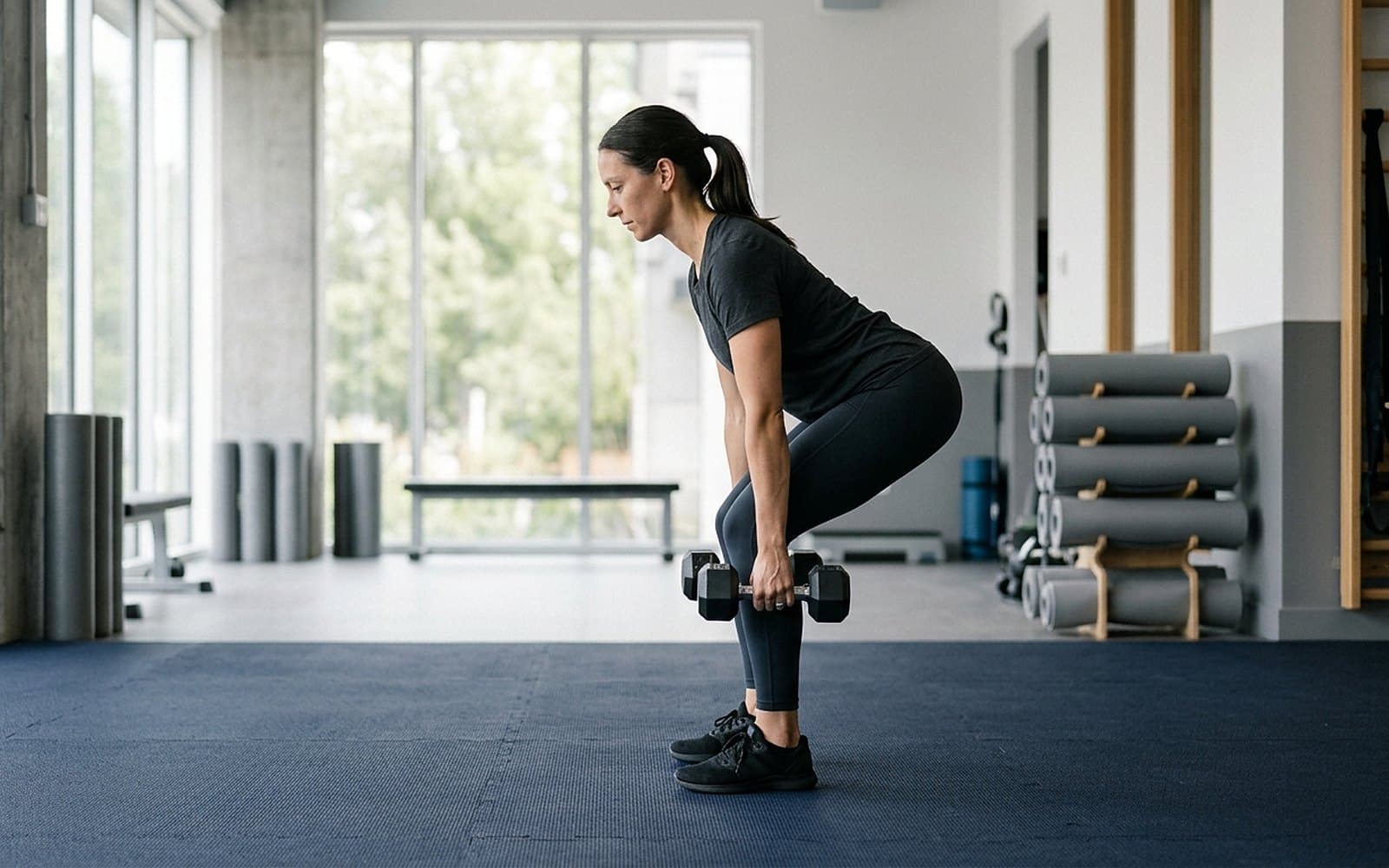
A 2024 randomised controlled trial by Rosenfeldt and colleagues is a great place to start.1 They recruited 18 healthy, physically active adults and split them into three groups. One group did resistance training: straight-legged deadlifts and modified Jefferson curls, taking the hamstrings and lower back through a large range of motion. A second group did sustained static stretches for the same muscles, and a control group did neither. Both exercise groups trained three times a week for eight weeks, with exercise time matched between them. Flexibility was measured with a sit-and-reach test, and strength with an isometric straight-legged deadlift.
The conclusion? Both interventions worked. After eight weeks, the two exercise groups improved their sit-and-reach by a similar amount, with no statistically significant difference between them:
| Group | Average improvement |
|---|---|
| Resistance training | +6.6 cm |
| Static stretching | +6.1 cm |
| Control | +0.8 cm |
Where they differed was strength: the resistance training group also gained significantly more strength than the stretching group. In other words, stretching helps, but it isn't the only way to stay limber. A well-designed strengthening program can achieve the same flexibility gains, and make you stronger at the same time.
What does this mean for your tight muscles?
Now let's take some common, more pathological examples, where someone has a specific area that feels tight or sore.
1. Tight hamstrings
Firstly, is it actually a hamstring problem? Your hamstrings start at your sit bones (the ischial tuberosities) at the back of your pelvis and run down to just below your knee. If your pelvis sits tipped forwards in an anterior pelvic tilt, those sit bones move up and back, shifting the hamstrings' starting point further away from where they finish. The result is that your hamstrings are already on a “pre-stretch” before you've even moved. When you then bend forward to touch your toes, they run out of range sooner and feel tight, even though the muscle itself isn't short.
In this case, the hamstrings are often the victim rather than the culprit. The answer is commonly to address tightness through the hip flexors, rectus femoris or lower back extensors that is tipping the pelvis forwards, before trying to settle the increased tone in the hamstrings. Stretching the hamstrings harder won't fix a pelvis that keeps pulling them on stretch.
Secondly, are your hamstrings strong enough for what you ask of them? A commonly used benchmark is the hamstring-to-quadriceps (H:Q) strength ratio: the hamstrings are typically expected to produce around 60% of the strength of the quadriceps, with a higher ratio expected at faster movement speeds. But how strong your hamstrings need to be depends on the person. During sprinting, the hamstrings are estimated to handle forces of up to around eight times body weight as the leg swings through to strike the ground.5 A sprinter's strength requirement is therefore far higher than someone whose training is a morning walk and a few gym sessions a week.
If strength is the missing piece, this is where resistance training earns its place. Exercises such as Romanian deadlifts and appropriately progressed Jefferson curls challenge your hamstrings through progressively greater ranges of motion while requiring them to produce force. During a Romanian deadlift, your hamstrings lengthen as you hinge forwards at the hips, so by gradually increasing your comfortable range and building strength within it, you can improve both mobility and strength. That doesn't mean loading as heavily as possible or forcing yourself into the deepest position: start with a manageable weight and range, then progress gradually as your tolerance improves.
2. Tight upper trapezius and shoulders
Another common complaint is tightness around the neck and upper shoulders, particularly in people who spend long hours at a computer. You might find yourself repeatedly stretching your upper trapezius, only for that familiar tight feeling to return later in the day. That doesn't mean stretching is useless: it may help you feel more comfortable and improve your neck's range of motion in the short term. But if the tightness keeps coming back, it's worth asking why these muscles aren't coping with the demands placed on them throughout the day.
This is where it matters which kind of “tight” upper trapezius you have. Some people have an upper trapezius that is genuinely weak and needs strengthening. This often shows up as drooped, downward-sloping shoulders, giving the neck and shoulders a more triangular shape. Others have an upper trapezius that is overloaded, holding increased tone because of a weakness elsewhere, most commonly the lower trapezius and mid-back. This pattern is more typical in people with rounded shoulders and a more rounded upper back (thoracic kyphosis), and here the focus shifts to strengthening the lower trapezius and upper back, rather than loading the upper trapezius further.
A 2024 systematic review of exercise for office workers with chronic neck pain found that strengthening the neck, shoulder and shoulder blade muscles can help reduce pain and disability, although the overall certainty of the evidence was low.3 One limitation of this research is that the trials generally didn't distinguish between a weak upper trapezius and an overloaded one compensating for a weaker mid-back. Instead, everyone received a broad, “kitchen sink” strengthening program.
Strengthening is the answer, but it needs to be specific. In fact, an earlier trial found that strength training targeting the neck and shoulder muscles reduced neck muscle pain far more than general fitness training did.4 The more precisely we can identify which muscles aren't coping, the better targeted, and more effective, your program can be.
So, should you stop stretching?
Not at all! Stretching remains an effective way to improve flexibility, and there's no reason to abandon it if you enjoy it or find it helpful. For the healthy person simply looking to stay limber, stretching and full-range strength training are both good options, and strength training comes with the bonus of making you stronger. In fact, you don't necessarily need a completely separate stretching program if your existing strength training already takes your muscles through the range you want.
For a muscle that keeps feeling tight, though, the question isn't really “stretch or strengthen?”. It's “why is this muscle not coping?”. It might be weak itself, it might be covering for a weaker muscle elsewhere, or it might be placed at a disadvantage by how your body is positioned. The answer to that question is what tells us whether to stretch, strengthen, or address something else entirely.
Stretching isn't the only way to improve flexibility. Research shows that resistance training through a large range of motion can improve flexibility just as well, with the added benefit of building strength.12 But a tight muscle is a muscle that isn't coping, not a muscle that is short, so the best response depends on finding out why.
At Move Physiotherapy, that's exactly what we look for. We assess what's actually driving your tightness, then build a practical program that improves your movement, strength and confidence. Sometimes the answer to feeling tight isn't stretching more, but finding out what your body can do through a greater range of motion.
Daniel focuses on reducing pain and restoring comfortable movement, combining hands-on treatment with gym-based strength rehabilitation. A former national javelin thrower for Singapore, he brings a strong understanding of athletic demands and returning to performance after injury.
References
- Rosenfeldt M, Stien N, Behm DG, Saeterbakken AH, Andersen V. Comparison of resistance training vs static stretching on flexibility and maximal strength in healthy physically active adults, a randomized controlled trial. BMC Sports Sci Med Rehabil. 2024;16:142.
- Afonso J, Ramirez-Campillo R, Moscão J, et al. Strength training versus stretching for improving range of motion: a systematic review and meta-analysis. Healthcare (Basel). 2021;9(4):427.
- Jones LB, Jadhakhan F, Falla D. The influence of exercise on pain, disability and quality of life in office workers with chronic neck pain: a systematic review and meta-analysis. Appl Ergon. 2024;117:104216.
- Andersen LL, Kjaer M, Søgaard K, et al. Effect of two contrasting types of physical exercise on chronic neck muscle pain. Arthritis Rheum. 2008;59(1):84–91.
- Sun Y, Wei S, Zhong Y, et al. How joint torques affect hamstring injury risk in sprinting swing-stance transition. Med Sci Sports Exerc. 2015;47(2):373–380.