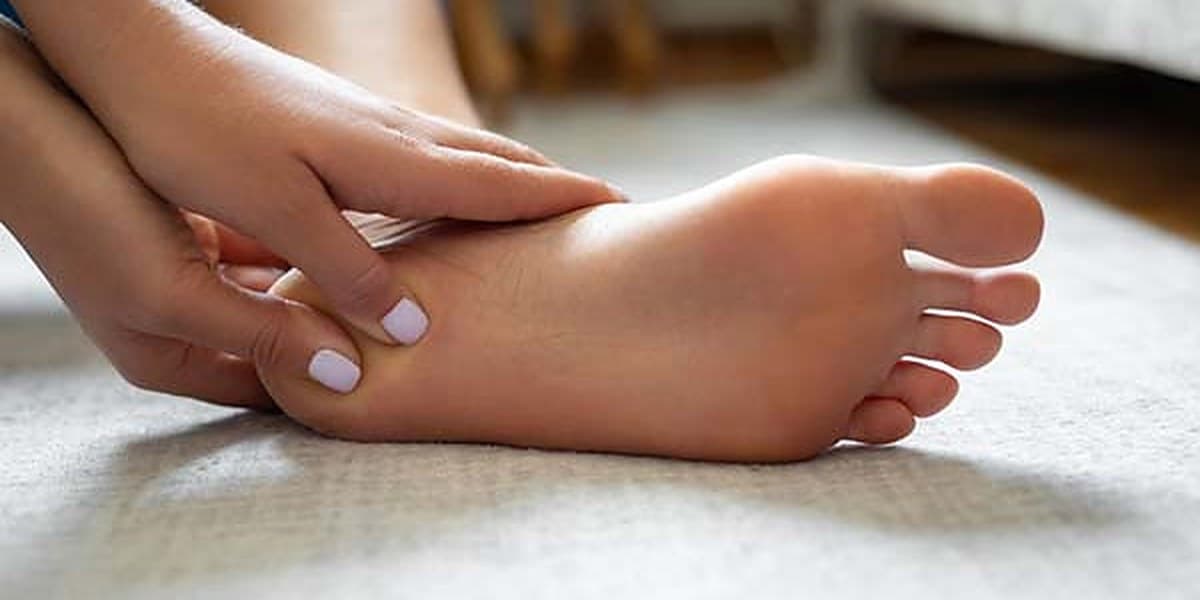

You woke up, swung your legs out of bed, and the first step hit like a knife into your heel. By the time you'd shuffled to the kitchen the pain eased off, but it came back after lunch when you stood up from your desk. Now it has been six weeks. You've tried rolling a frozen water bottle, stretching the calf morning and night, and you've started wondering whether you need orthotics.
Plantar fasciitis affects roughly 10% of adults at some point in their lives.1 It is the most common cause of heel pain we see in the clinic. And it is the condition where the gap between what people try and what actually works is among the widest in musculoskeletal practice.
Most heel pain sufferers reach for passive solutions: rest, ice, a soft soled shoe, a chemist orthotic, maybe a cortisone injection if it drags on. Some go straight for custom orthotics. The evidence tells a different story. Plantar fasciitis is fundamentally a load tolerance problem, and the highest quality trials in the last decade have shifted the treatment model from passive support to active loading. That shift is where physiotherapy comes into its own.
What plantar fasciitis actually is
The name is misleading. The "-itis" suffix implies inflammation, but biopsy and imaging studies show plantar fasciitis is a degenerative tendinopathy-like condition, not an inflammatory one.2 Researchers increasingly call it plantar heel pain or plantar fasciopathy. The plantar fascia is a thick fibrous band running from the heel bone to the base of the toes. Under repeated load it gets irritated, develops microscopic disorganisation, and becomes pain sensitive.
This matters because the treatment implications are completely different. If it were truly inflammatory, anti-inflammatory drugs and rest would be the answer. Because it is a load tolerance problem, the answer is to gradually rebuild that load tolerance, much like rehab for an Achilles tendinopathy.
The most consistently identified risk factors in the literature are: high BMI, prolonged standing, reduced ankle dorsiflexion range, and sudden increases in load.3,4 Foot posture matters in some cases, but plenty of people with flat feet never develop plantar fasciitis, and plenty of people with neutral arches do. If you understand plantar fasciitis as a tissue that has lost the capacity to handle the demands placed on it, the path forward becomes clear: temporarily reduce demand, gradually rebuild capacity, and address the upstream factors that loaded the tissue inappropriately in the first place.
Rest and stretch: when it works, and when it doesn't
The most common playbook for treating plantar fasciitis goes something like this. Rest from running or aggravating activity. Stretch the calf. Roll the foot on a ball or frozen bottle. Buy supportive shoes or arch supports.
For standard, short term presentations this is often enough. Most acute episodes settle within a few weeks once the load comes down and basic mobility work is done consistently. If your plantar fasciitis is genuinely recent and not severe, the standard playbook has a reasonable chance of resolving it on its own.
Chronic, long term plantar fasciitis is a different problem. Once the fascia has been pain sensitive for months rather than weeks, the tissue has lost capacity — and capacity has to be actively rebuilt. Long term cases need a strengthening component, and not just the calf. The plantar fascia itself responds to direct loading. Tibialis posterior, the intrinsic foot muscles, and the gluteal muscles up the chain all need attention, because force travels down through the leg before it ever reaches the fascia. Even within the stretching world, plantar fascia specific stretching — where you bend the toes back to load the fascia directly — outperforms calf stretching alone.5 But stretching of any kind takes a back seat to progressive strength work for chronic cases.
The intervention that has repeatedly outperformed stretching in randomised trials is high load strength training. In Rathleff's landmark 2015 trial, patients who did a heavy slow calf raise protocol with the toes extended over a rolled towel — which preloads the plantar fascia — had significantly better function scores at three months than patients doing plantar fascia specific stretching alone.6 The strength group worked every second day. The differences emerged at 12 weeks and held up at 12 months. This protocol is now broadly considered standard care for chronic plantar heel pain, alongside education and load management.
The treatment shift
Passive support manages symptoms. Progressive loading changes the underlying problem. The strongest evidence in the last decade points to one conclusion: rebuild what the tissue can tolerate, and the pain follows.