
“Weak glutes” is one of the most overused phrases in physiotherapy. Walk into any gym, scroll any fitness account, ask any personal trainer about your knee or back pain, and someone will tell you your glutes are weak. Most of the time, the diagnosis is delivered without a single objective test.
That is a problem. Some people genuinely do have weak glutes that need addressing. Other people are running around treating glutes that are working perfectly fine. The only way to know which category you fall into is to actually measure.
This is the first piece in our Move Movement Screen series. We're going to give you three home tests with the research-based norms, so you can find out for yourself. Then we'll explain why this matters more than most people realise — and what to do if you fall short.
Quick primer: which glute, and why
The glutes are not one muscle. They are three: gluteus maximus, gluteus medius, and gluteus minimus. For our purposes, we're focused on the first two.
The gluteus maximus is the largest muscle in the body. Its main job is hip extension — pushing the leg backward, driving the hips forward. It powers walking, running, squatting, climbing stairs, getting out of a chair. It is the prime mover for almost every functional lower body task.
The gluteus medius is smaller and sits on the side of the hip. Its main job is hip abduction (lifting the leg out to the side) and — more importantly — preventing the opposite side of the pelvis from dropping when you stand on one leg. Every time you take a step, the gluteus medius on the planted leg has to hold your pelvis level. This is its single most important function, and it is the function most commonly impaired.
Weakness in either muscle shows up differently. Maximus weakness shows up as poor power output — slow stair climbing, struggle getting out of a chair, reduced sprinting power. Medius weakness shows up as faulty mechanics — your knee falls inward when you squat, your hip drops when you run, your form breaks under fatigue.
The three tests
These tests target glute maximus endurance, glute medius endurance, and dynamic glute medius control. You'll need a stopwatch (your phone is fine), a clear floor, and a mirror or someone to watch you for the third test.
A note before we start: the published norms below come from studies on young adults, mostly university-age. If you are in your 40s, 50s, or beyond, your numbers will likely trend lower than these, and that is normal. Use the benchmarks as a target, not as a verdict.
Test 1: Single-leg glute bridge hold (gluteus maximus)
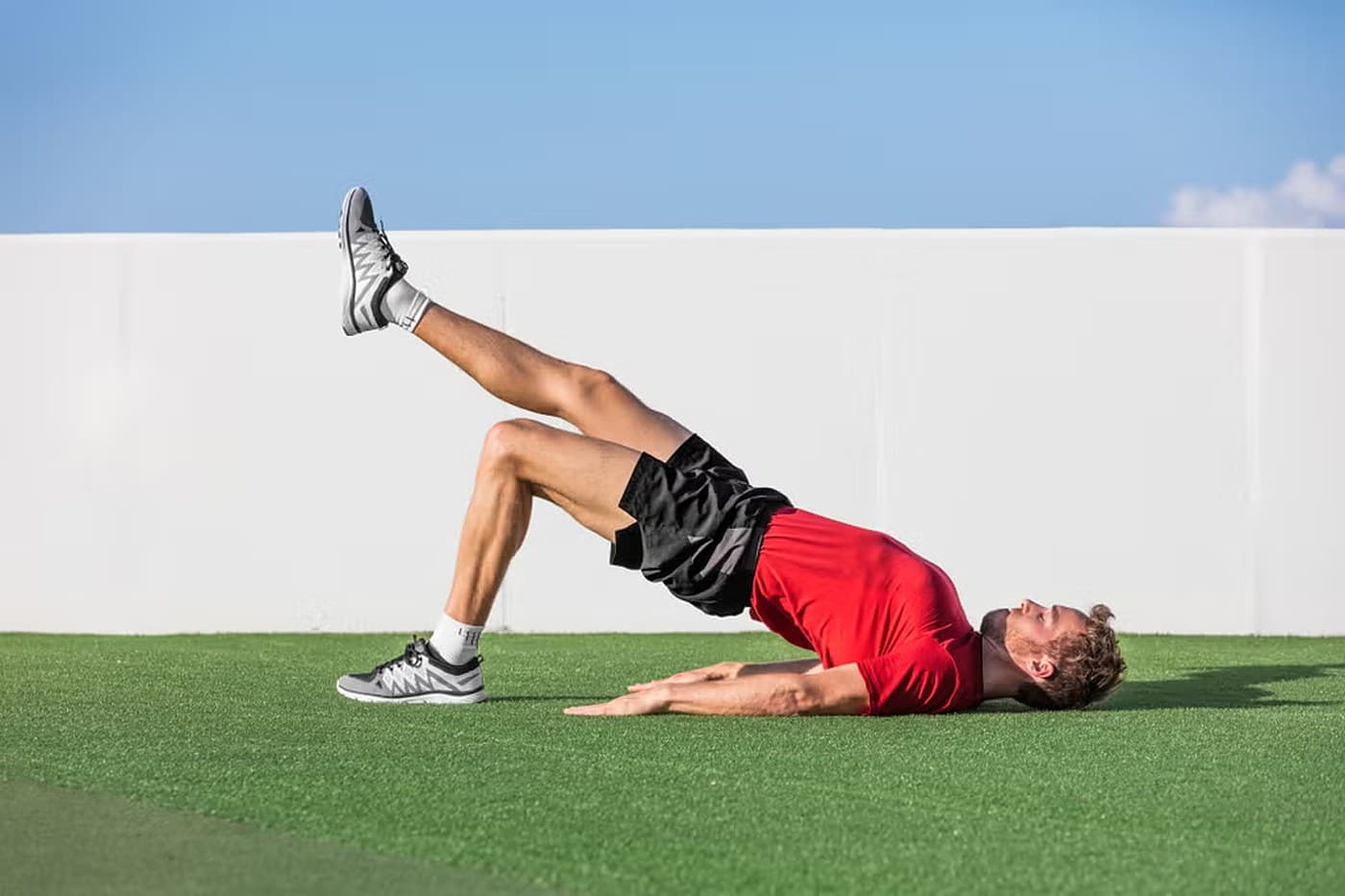
Lie on your back, knees bent to about 90 degrees, feet flat on the floor. Lift one leg off the ground and straighten it. Push through the heel of the planted foot and lift your hips until your body forms a straight line from shoulder to knee. Hold this position. Time how long you can maintain it before your hips drop or your form breaks down. Repeat on the other side.
The norm. A 2026 study in asymptomatic young adults found average hold times of approximately 65 seconds on the dominant leg and 64 seconds on the non-dominant leg.1 An earlier protocol (the Glute Endurance Measure–B) reported a mean of 81 seconds.2 In clinical practice, we use 60 seconds as a working benchmark — pragmatic rather than statistically perfect, but a fair line in the sand.
Passing looks like: at least 60 seconds each side, with less than 10 percent difference between sides.
Failing looks like: under 30 seconds, a large asymmetry between sides (more than 20 percent), or your hamstring cramping before your glute fatigues. The cramping hamstring is the giveaway — it's doing the work the glute should be doing.
Test 2 (Gold Standard): Side plank with leg lift (gluteus medius)
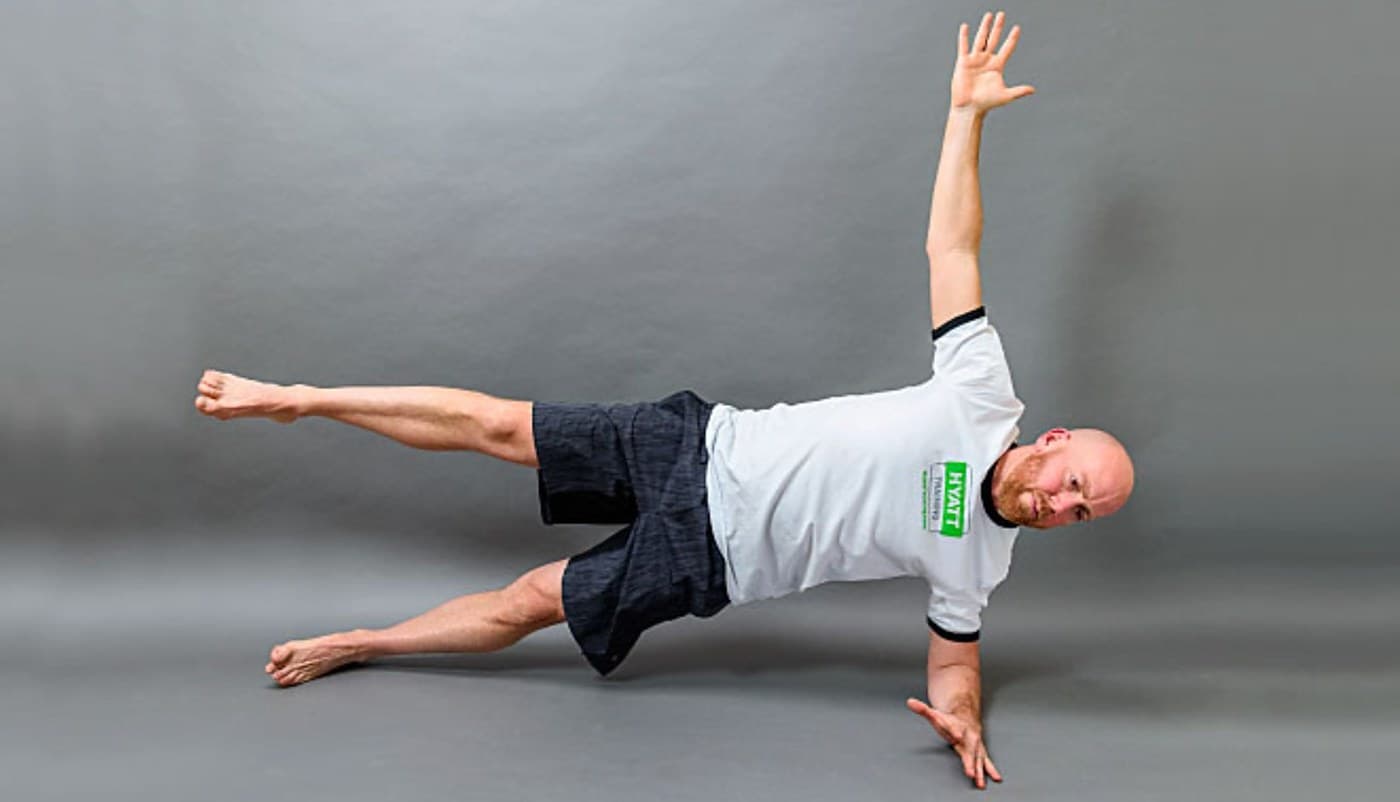
This is the gold standard for isolating the gluteus medius. A 2011 EMG study by Boren and colleagues tested 18 common glute exercises and found that side plank with hip abduction produced the highest gluteus medius activation of any exercise measured — over 100 percent of maximum voluntary contraction.3 No other movement comes closer to a clean isolation challenge for the glute medius. If you want to know whether yours is actually doing its job, this is the test that asks the right question.
How to perform it. Lie on your side with your forearm beneath your shoulder and legs straight and stacked. Lift your hips off the floor so your body forms a straight line from shoulder to feet. From there, lift your top leg up to roughly 30 to 40 degrees of abduction, hold for a beat, then lower under control. Continue at a steady cadence for as many reps as you can hold good form. Repeat on the other side.
Passing looks like: at least 10 controlled reps each side, smooth tempo, hip held high throughout, with less than 10 percent difference between sides. As we get into late middle age, we perform the same test with the bottom knee bent — many people fail it entirely, and it is one of the most common drivers behind gluteal tendinopathies and hip bursitis.
Failing looks like: under 10 reps before form breaks, the side plank sagging before the leg lift fails (a sign your lateral chain gives out before the glute does), the side or top of your hip burning before your glute (tensor fasciae latae compensation), or significant asymmetry between sides.
Test 3: Single-leg squat quality (dynamic hip control)
This is not a strength test. It is a control test. Stand on one leg in front of a mirror, or have someone film you from the front. Squat down as far as you can with control, then stand back up. Do five reps each side. Watch for four things:
- Knee valgus — does the knee fall inward, toward the midline?
- Pelvic drop — does the opposite side of the pelvis drop down?
- Trunk lean — do you lean over the squatting leg to keep balance?
- Heel rise — does your heel come off the floor?
A clean single-leg squat keeps the knee tracking over the second toe, the pelvis level, the trunk upright over the planted leg, and the heel grounded. Depth should approximately match your two-leg squat depth.
Failing looks like: any of the four faults appearing within the first few reps. Knee valgus and pelvic drop are the two most common, and both point at gluteus medius dynamic control deficits — even if your hold-time on Test 2 was fine. People can pass the strength tests and still fail the control test, and vice versa. Both pieces matter.