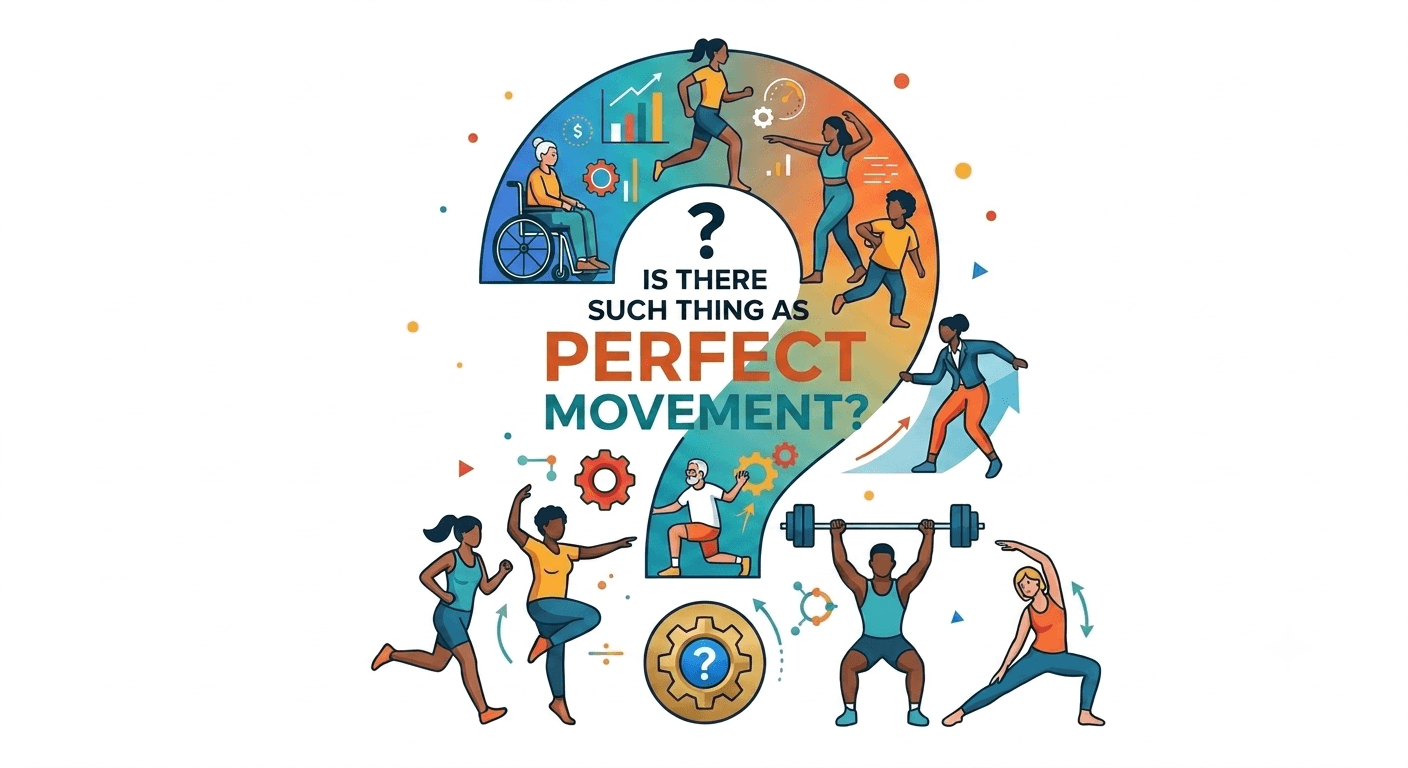

As a clinician, I'm constantly working to help people move well. But "well" doesn't mean textbook perfect, and it never has. Perfect movement is a genuinely useful clinical idea, and also a standard nobody actually meets. Knowing the difference is most of the job.
So can we define perfect movement?
"Perfect movement" is simply a reference point: a clinical framework built around comparing a person's own movement to a standardised pattern.1,2 Systems like the Selective Functional Movement Assessment define this for everyday tasks: bending and touching your toes, reaching overhead, squatting, and similar patterns most people perform daily.
That reference point was never meant to be handed to a patient as a target they have to hit. It exists so clinicians understand how joint and muscle demands shift as someone's own pattern moves away from it, not to make anyone feel vulnerable for not matching a textbook norm. Individual variance, much of it simply structural or genetic, isn't something to correct or apologise for.
With all movement, we're aiming for something smooth, pain-free and effortless. But just as important is getting contributions from as many body parts as possible. A toe-touch, for instance, draws on hamstring length, neural mobility, spinal flexion, hip flexion and mid-back flexion all at once. That spread is exactly what builds in redundancy: if one of those areas is injured, the others can still carry the movement, so an ordinary task like bending down doesn't become debilitating. Being close to that reference pattern, then, isn't the point in itself. It's more that it tends to be a sign those multiple systems are all still doing their share.
This same reference point also tells us where load travels. Movement pattern A loads structures B, C and D; change the pattern and you change where that load goes. Say a "perfect" toe-touch shares load evenly across the hamstrings, hips, and lumbar and thoracic spine. Someone with tighter hamstrings will find that same range somewhere else instead, perhaps bending more through the hips and spine. That's strategy B loading structures C and D a little more.
The same logic applies to weakness, not just tightness. Bending down to lift something loads the glutes, hamstrings and back together; weakness through the glutes and hamstrings shifts more of that work onto the back.
However, you are not meant to be "perfect"
There's real evidence behind that. Therapists who are overly critical can incite a sense of vulnerability and fear of future injury.3 And research on movement variability has found that healthy movement isn't perfectly repeatable in the first place: some natural variation from rep to rep is a normal feature of a well-functioning system, not a flaw to correct out of existence.4
There's a third piece worth adding: injury from daily movement is genuinely uncommon. Human tissue is biological, and it adapts to gradual increases in the stress placed on it.5 Problems tend to start when load spikes faster than a structure can recover, not from movement itself.
This is also where more "perfect" technique genuinely earns its place. Biasing the strongest, most robust structures to carry load isn't pedantry, it's the difference between a task staying easy and a task becoming an injury. Take lifting something off the ground: the glutes and hamstrings are large, robust muscles, and the glute max is one of the thickest in the body, built to be the prime mover for hip extension in exactly that movement. The lumbar extensors are smaller and simply not built to do that same job, which is why asking them to take over tends to end in tightness or overload.
The higher the load, or the more times a task gets repeated, the more that technique matters, and the less room there is to get it wrong. A single awkward bend to pick up a piece of paper barely registers. The same awkward pattern under 100kg, or repeated for the hundredth time in a shift, is a completely different proposition. This is exactly where a genuinely "perfect" pattern, or as close to it as a person can manage, stops being a nice-to-have and becomes the thing standing between a heavy lift and an injury.
This changes when you're injured
There's a related concept worth naming here: degrees of freedom, the many different ways a joint or limb system is mechanically free to move to achieve the same task.6,7 During an injury, and really only during an injury, deliberately restricting some of those degrees of freedom can be genuinely useful. It lets someone keep moving, exercising and loading their body while protecting the specific structure that's actually hurt.
Take someone whose lower back is aggravated specifically by flexion, where forward bending brings symptoms on but nothing else does. The degree of freedom worth restricting there is fairly specific: lumbar flexion. That doesn't mean the whole training plan stops. Lateral movements, rotational work, or a hip hinge kept in a neutral spine can still load the back and the rest of the body without ever asking that flexed position to do anything at all. The person keeps training, keeps loading everything that isn't the problem, and the one direction that actually needs protecting gets left alone until it's ready.
The more precisely we understand the biomechanics of a movement, the more specifically we can restrict just the degrees of freedom that matter and load everything else as normal. That precision is what lets someone keep training through an injury with fewer of the downstream complications that come from simply avoiding movement altogether.
Once someone isn't injured, the goal flips: we want more degrees of freedom back, not fewer. There's a real reason behind the old strength-and-conditioning idea of "training ugly", deliberately allowing looser, less rigid technique once the loads involved are genuinely appropriate for the person. It often gets folded into the same conversation as "perfect technique", when really it's the other half of the same idea: movement options should expand and contract based on what a person's tissue can actually handle, not stay fixed at one standard regardless of context.
The goal is options, not a verdict
The actual goal is roughly equal contribution from as many areas as possible to a movement, not perfect mobility at any one joint. Squatting, reaching, bending forward: all of these draw on the hips, spine, knees and ankles together. Redundancy is the point. If one of those areas is injured, whether acutely or through a chronic issue, the others can still get the job done.
It's unreasonable to expect anyone to have perfect, textbook-matching mobility. But the closer someone can move toward it, the more options they genuinely have for achieving the same daily task. That's really what all of this comes down to: making sure nobody is stuck with only one way of moving. A structure loaded the exact same way, in the same spot, thousands of times a week with zero variation, is a structure that never gets a break.
Which brings this back to where it started: perfect movement, and the norms built around it, are genuinely useful. They tell us how load moves through the body, when a pattern actually needs to change and when it doesn't, and exactly how much to restrict around a real injury without shutting a person down completely. Used that way, as a reference point for reasoning, they're doing exactly the job they were built for.
The line between using this well and using it badly comes down to who the reference point is actually for. It's good when it stays a clinical tool: reasoning through why a pattern loads certain structures, deciding how much movement to restrict around a genuine injury, or working out where someone's options have narrowed and why. It's bad the moment it gets handed to a patient as a standard to meet, used to make someone feel fragile about a squat or a stride that was never actually dangerous, or stretched into a reason for treatment that never ends. Same concept, used two completely different ways, with two completely different outcomes for the person on the other end of it.
Masters of Physiotherapy, University of South Australia. Founded Move Physiotherapy in 2018. Provides match day services to sporting clubs across Perth, with a focus on evidence-based rehabilitation and objective return-to-sport testing.
References
- Cook G, Burton L, Hoogenboom BJ, Voight M. Functional movement screening: the use of fundamental movements as an assessment of function – part 1. Int J Sports Phys Ther. 2014;9(3):396–409.
- Cook G, Burton L, Hoogenboom BJ, Voight M. Functional movement screening: the use of fundamental movements as an assessment of function – part 2. Int J Sports Phys Ther. 2014;9(4):549–563.
- Darlow B, Dowell A, Baxter GD, Mathieson F, Perry M, Dean S. The enduring impact of what clinicians say to people with low back pain. Ann Fam Med. 2013;11(6):527–534.
- Stergiou N, Decker LM. Human movement variability, nonlinear dynamics, and pathology: is there a connection? Hum Mov Sci. 2011;30(5):869–888.
- Mueller MJ, Maluf KS. Tissue adaptation to physical stress: a proposed "physical stress theory" to guide physical therapist practice, education, and research. Phys Ther. 2002;82(4):383–403.
- Vereijken B, van Emmerik REA, Whiting HTA, Newell KM. Free(z)ing degrees of freedom in skill acquisition. J Mot Behav. 1992;24(1):133–142.
- Guimarães AN, Ugrinowitsch H, Dascal JB, Porto AB, Okazaki VHA. Freezing degrees of freedom during motor learning: a systematic review. Motor Control. 2020;24(3):457–471.